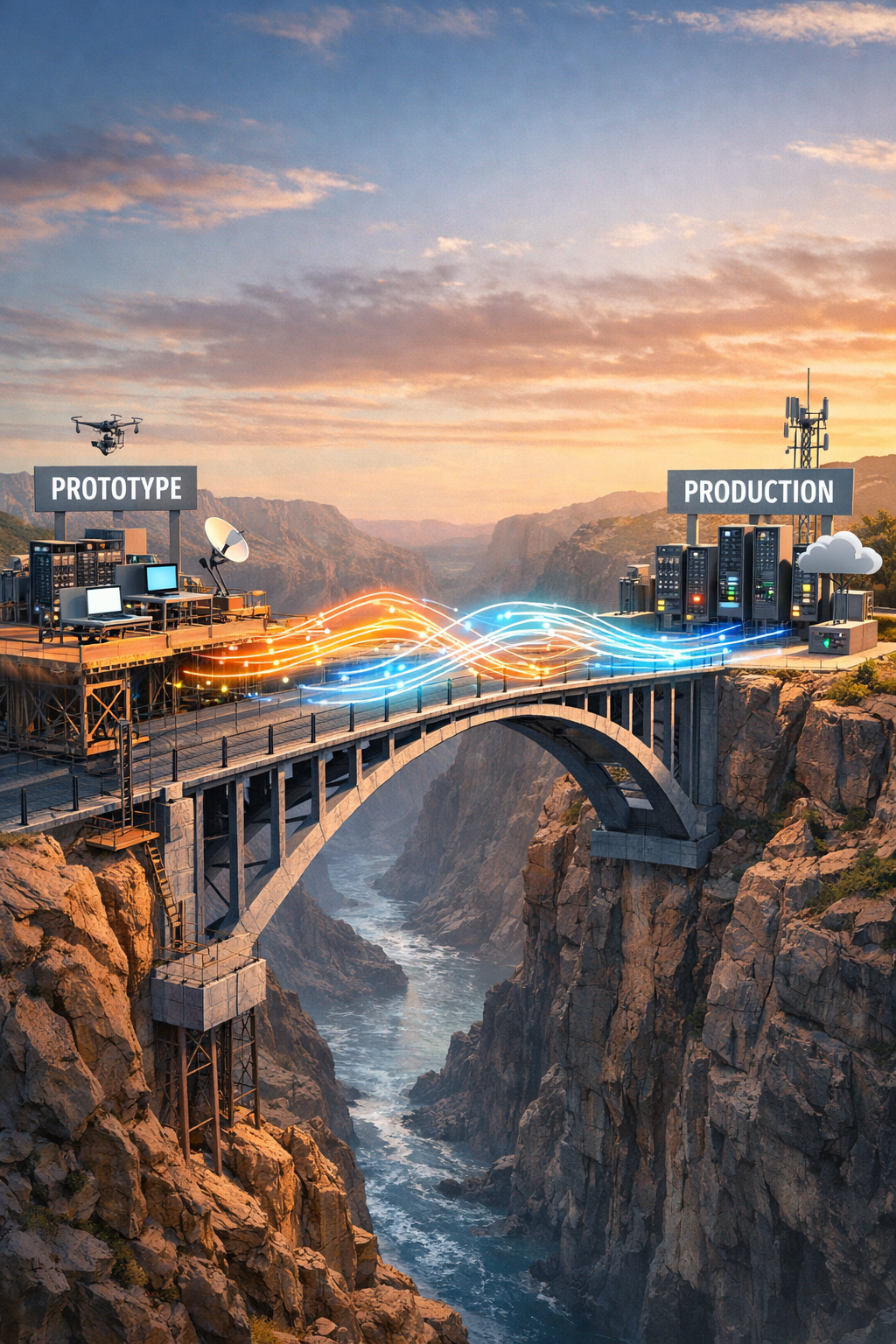
The journey of an AI project is often a tale of two phases. The first is filled with excitement: a promising prototype is built, demonstrating impressive accuracy on a curated dataset. The second phase, however, is where reality sets in. Moving from a prototype to a robust, scalable production system is a monumental challenge that many organizations fail to overcome. This chasm—the gap between a working model and a reliable, value-generating application—is one of the most significant hurdles in modern technology adoption. At Donkey Ideas, we see this transition not as a technical afterthought, but as the core of successful AI implementation.
Why the Prototype-to-Production Gap Exists
The gap exists because building a prototype and engineering a production system require fundamentally different mindsets and skill sets. A prototype is a proof-of-concept, optimized for speed and validation. It often runs on a single machine, uses static or sample data, and is maintained by the data scientists who built it. A production system, in contrast, must be resilient, scalable, monitored, and integrated into existing business workflows. It requires considerations for data drift, model retraining, latency, security, and cost management that are rarely addressed in the initial phase. According to a VentureBeat analysis, a staggering number of data science projects never make it to production, often due to this disconnect.
Key Pillars for a Successful Transition
Closing this gap requires a structured approach focused on several key pillars beyond just the model's accuracy.
1. MLOps: The Engineering Discipline for AI
MLOps, or Machine Learning Operations, is the practice of applying DevOps principles to the machine learning lifecycle. It's the framework that enables continuous integration, delivery, and monitoring of ML models. Implementing MLOps means automating the pipeline from data preparation and model training to deployment and performance tracking. This ensures models can be updated reliably and their behavior can be understood in real-time. Tools and platforms that support versioning for data, code, and models are essential here.
2. Robust Data Infrastructure and Monitoring
A model is only as good as the data it receives in production. You need pipelines that can handle live, often messy, data at scale. More importantly, you must monitor for concept drift—when the statistical properties of the target variable change over time—and data drift—when the input data distribution changes. Without monitoring, a model's performance can degrade silently, eroding business value. Establishing a feedback loop where production performance informs retraining is critical.
3. Scalable and Responsible Deployment
Deployment architecture is paramount. Will the model run as a real-time API, a batch processing job, or on the edge? Considerations for load balancing, containerization (using Docker, Kubernetes), and cost-effective cloud resources are engineering tasks that differ from data science. Furthermore, responsible AI practices, including fairness, explainability, and privacy, must be baked into the production system, not bolted on later. The Google AI Principles offer a strong foundation for this thinking.
The Venture Building Mindset for AI
At Donkey Ideas, we apply our venture building methodology to AI projects. This means treating the AI system as a product from day one. We build cross-functional teams that include not only data scientists but also software engineers, DevOps specialists, and product managers. This ensures production requirements are considered during the prototyping phase, significantly reducing integration friction later. Our approach focuses on delivering a minimum viable product (MVP) that is, by definition, production-ready and designed to scale, which you can explore in our portfolio of ventures.
Getting Started: A Practical Roadmap
Bridging the gap is a process. Start by defining clear success metrics for the production system that go beyond accuracy, such as inference latency, system uptime, or business KPIs. Next, invest in the foundational MLOps infrastructure early, even if it starts simple. Choose a deployment strategy that matches your use case's needs. Most importantly, foster collaboration between your data science and engineering teams. For organizations looking to build this capability, partnering with experts who have navigated this path can accelerate success. If you're ready to turn your AI prototype into a driving force for your business, reach out to our team to discuss how our venture building services can help.
Closing the AI gap is not merely a technical challenge; it's an organizational one. By prioritizing production readiness with the same rigor as model development, companies can unlock the true, sustainable value of artificial intelligence and move from fascinating experiments to transformative business assets.